eviden-logo

Evidian > Products > SafeKit: All-in-One SANless High Availability & Application Clustering Software > Milestone XProtect: the simplest high availability cluster between two redundant servers

Milestone XProtect: the simplest high availability cluster between two redundant servers

With the synchronous replication and automatic failover provided by Evidian SafeKit

How the Evidian SafeKit software simply implements a Milestone XProtect high availability cluster?

The solution for Milestone XProtect

Evidian SafeKit brings high availability to Milestone XProtect, the CCTV video surveillance system, between two redundant servers.

This article explains how to implement quickly a Milestone cluster with real-time replication and automatic failover of the management services and the SQL database. Management services and SQL can be split on several clusters.

Recorder redundancy

  • Replication of recorders is not suitable for SafeKit due to the volume of data.
  • The solution integrated into Milestone can be used (failover recording server without real-time replication).
  • Two recorders can also run in an active/active configuration and the cameras are distributed so as not to lose all the cameras in the same area in the event of a failure.
  • The stream from each camera can also be sent to two recorders with the Vega / RMF solution.

A generic product

Note that SafeKit is a generic product on Windows and Linux.

You can implement with the SafeKit product real-time replication and failover of any file directory and service, database, complete Hyper-V or KVM virtual machines, Docker, Podman, K3S, Cloud applications (see all solutions).

A complete solution

SafeKit solves:

  • hardware failures (20% of problems), including the complete failure of a computer room,
  • software failures (40% of problems), including restart of critical processes,
  • and human errors (40% of problems) thanks to its ease of use via its web console.

How the SafeKit mirror cluster works with Milestone XProtect and SQL?

Step 1. Real-time replication

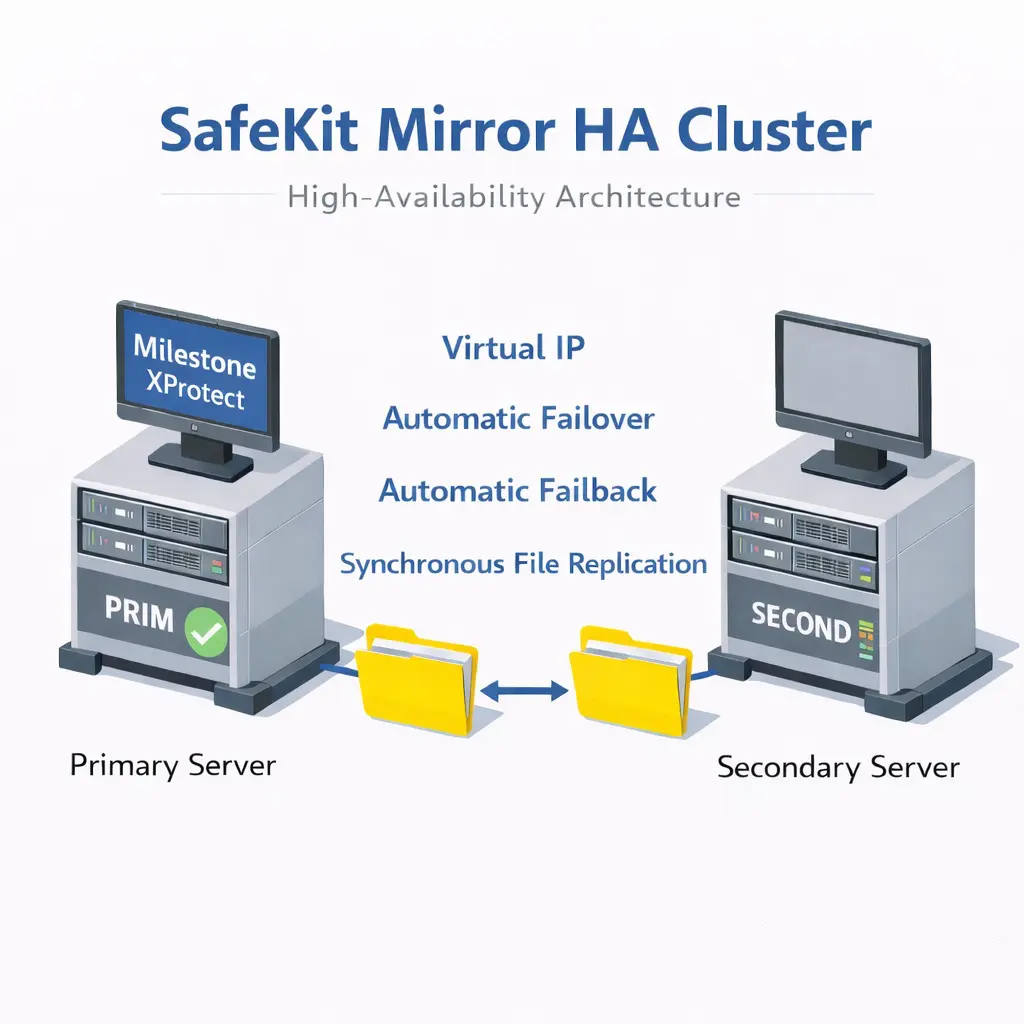
Server 1 (PRIM) runs the Milestone XProtect and SQL application. Clients are connected to a virtual IP address. SafeKit replicates in real time modifications made inside files through the network.

File replication at byte level in a mirror Milestone XProtect and SQL cluster

The replication is synchronous with no data loss on failure contrary to asynchronous replication.
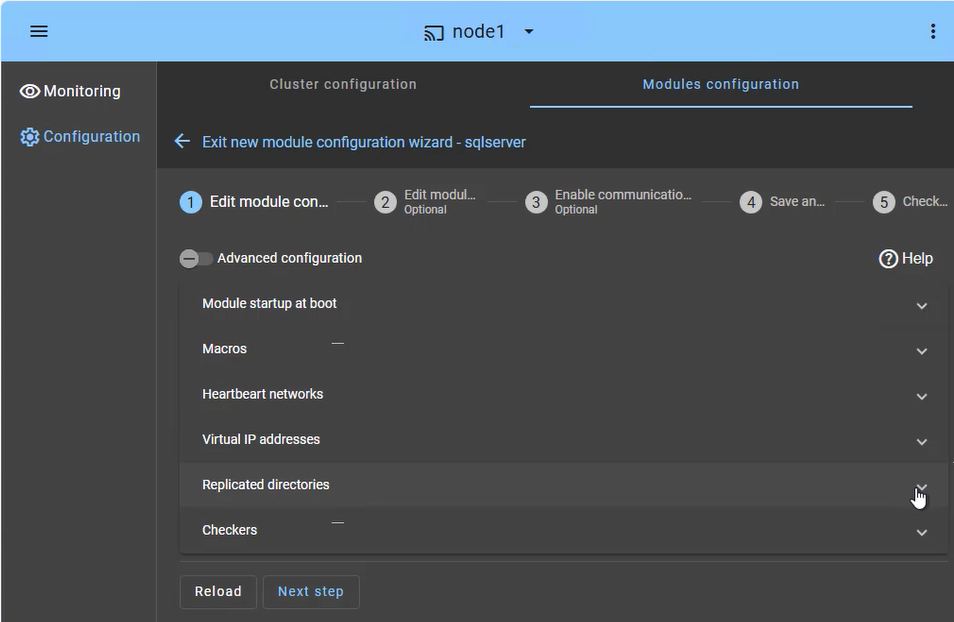
You just have to configure the names of directories to replicate in SafeKit. There are no pre-requisites on disk organization. Directories may be located in the system disk.

Step 2. Automatic failover

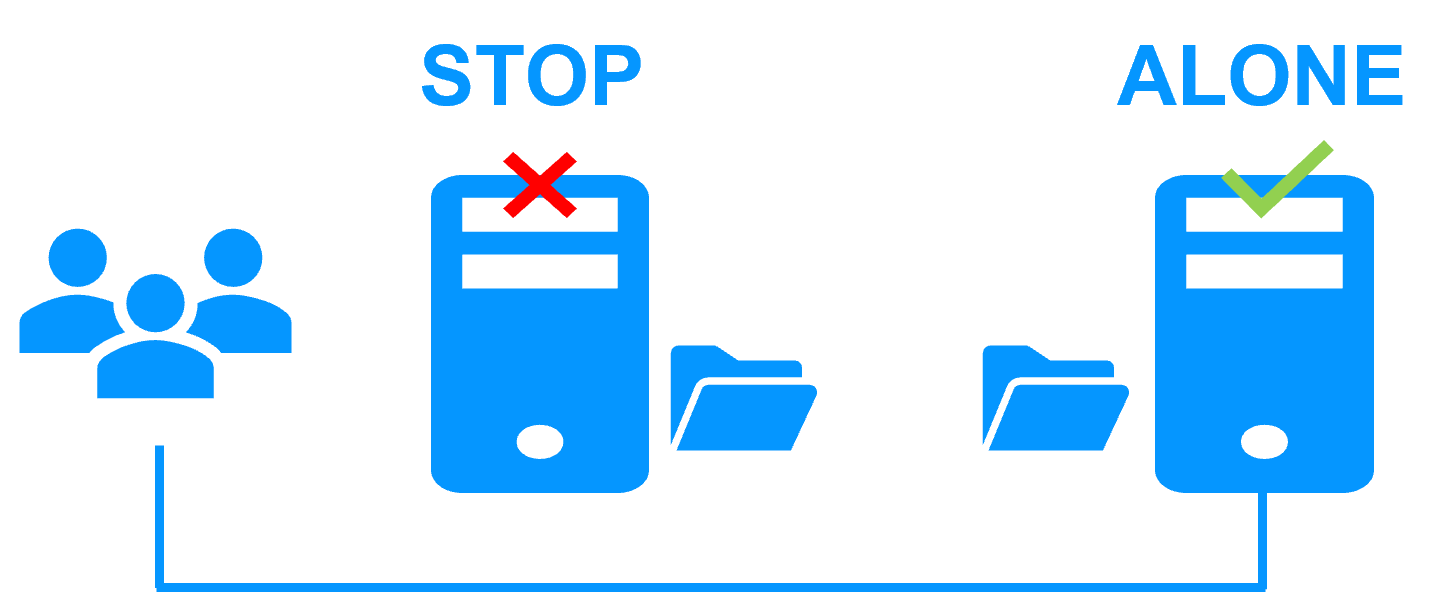
When Server 1 fails, Server 2 takes over. SafeKit switches the virtual IP address and restarts the Milestone XProtect and SQL application automatically on Server 2.
The application finds the files replicated by SafeKit uptodate on Server 2. The application continues to run on Server 2 by locally modifying its files that are no longer replicated to Server 1.

Failover of Milestone XProtect and SQL in a mirror cluster

The failover time is equal to the fault-detection time (30 seconds by default) plus the application start-up time.

Step 3. Automatic failback

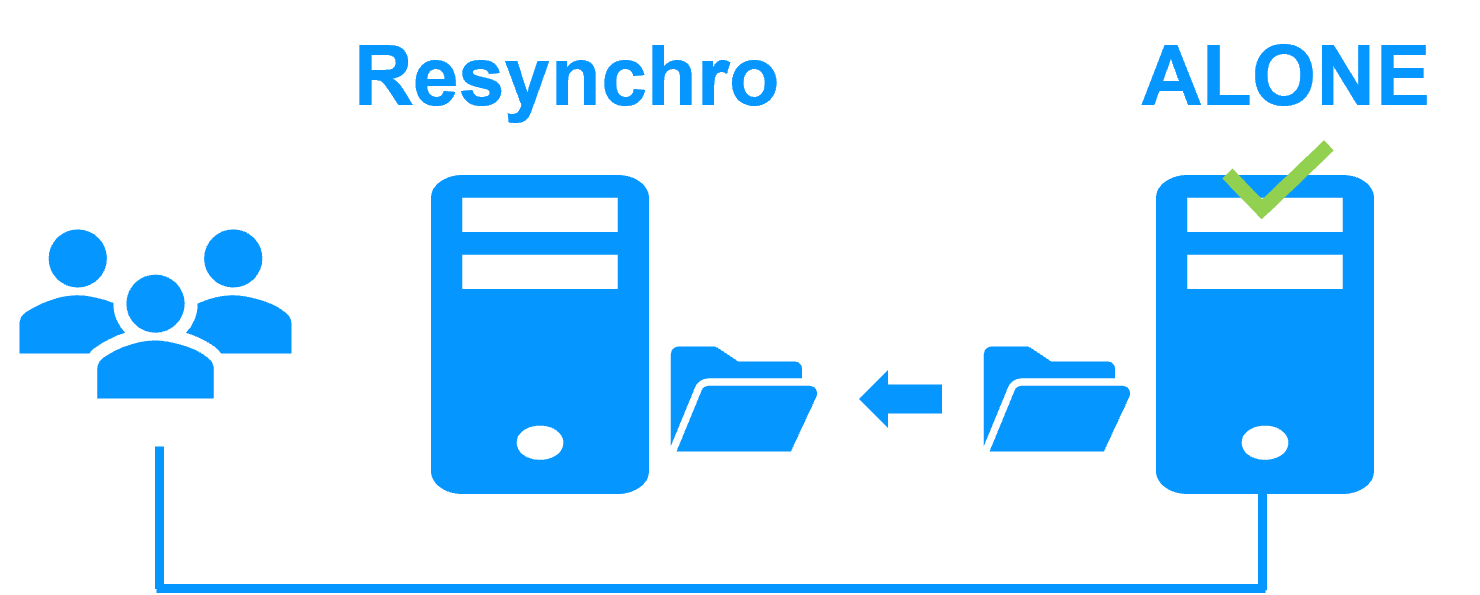
Failback involves restarting Server 1 after fixing the problem that caused it to fail.
SafeKit automatically resynchronizes the files, updating only the files modified on Server 2 while Server 1 was halted.

Failback in a mirror Milestone XProtect and SQL cluster

Failback takes place without disturbing the Milestone XProtect and SQL application, which can continue running on Server 2.

Step 4. Back to normal

After reintegration, the files are once again in mirror mode, as in step 1. The system is back in high-availability mode, with the Milestone XProtect and SQL application running on Server 2 and SafeKit replicating file updates to Server 1.

Return to normal operation in a mirror Milestone XProtect and SQL cluster

If the administrator wishes the application to run on Server 1, he/she can execute a "swap" command either manually at an appropriate time, or automatically through configuration.

SafeKit, a recognized solution on the security market

Milestone has chosen SafeKit

SafeKit is deployed in 30+ countries with the video management software of Milestone.

SafeKit is validated by Milestone for redundancy and high availability of the management server.

SafeKit is the best solution because it is purely software, completely hardware-agnostic.

Solution preferred by Siemens

SafeKit is available in the Siemens marketplace with its Siveillance suite (video and access control) and with its SCADA software: Desigo CC (building management), SIMATIC WinCC, SIMATIC PCS 7.

SafeKit is deployed by Siemens in Australia, France, the Netherlands, Qatar, Switzerland, the UAE, the UK, the US.

SafeKit recommended by Nedap

Nedap, a key player in physical access control, recommends SafeKit for redundancy and high availability of its AEOS application.

The Nedap/SafeKit solution is available with a free trial and a quick installation guide.

TIL Technologies has chosen SafeKit

SafeKit is deployed in 100+ customer sites by TIL Technologies for access control and building management.

SafeKit is the high availability option of MICROSESAME.

Innovation award in Video Management Software

Readers of Benchmark Magazine (specialized in physical security systems for resellers & SI) have voted for SafeKit as an innovation in Video Management Software.

This award shows the importance of redundancy in security offerings.

🔍 SafeKit High Availability Navigation Hub

Explore SafeKit: Features, technical videos, documentation, and free trial
Resource Type Description Direct Link
Key Features Why Choose SafeKit for Simple and Cost-Effective High Availability? See Why Choose SafeKit for High Availability
Deployment Model All-in-One SANless HA: Shared-Nothing Software Clustering See SafeKit All-in-One SANless HA
Partners SafeKit: The Benchmark in High Availability for Partners See Why SafeKit Is the HA Benchmark for Partners
HA Strategies SafeKit: Infrastructure (VM) vs. Application-Level High Availability See SafeKit HA & Redundancy: VM vs. Application Level
Technical Specifications Technical Limitations for SafeKit Clustering See SafeKit High Availability Limitations
Proof of Concept SafeKit: High Availability Configuration & Failover Demos See SafeKit Failover Tutorials
Architecture How the SafeKit Mirror Cluster works (Real-Time Replication & Failover) See SafeKit Mirror Cluster: Real-Time Replication & Failover
Architecture How the SafeKit Farm Cluster works (Network Load Balancing & Failover) See SafeKit Farm Cluster: Network Load Balancing & Failover
Competitive Advantages Comparison: SafeKit vs. Traditional High Availability (HA) Clusters See SafeKit vs. Traditional HA Cluster Comparison
Technical Resources SafeKit High Availability: Documentation, Downloads & Trial See SafeKit HA Free Trial & Technical Documentation
Pre-configured Solutions SafeKit Application Module Library: Ready-to-Use HA Solutions See SafeKit High Availability Application Modules
FAQ Frequently Asked Questions on Architecture, Technical specs, Features See SafeKit HA FAQ